The Visitor Is Already There. The Question Is How Long They Stay.
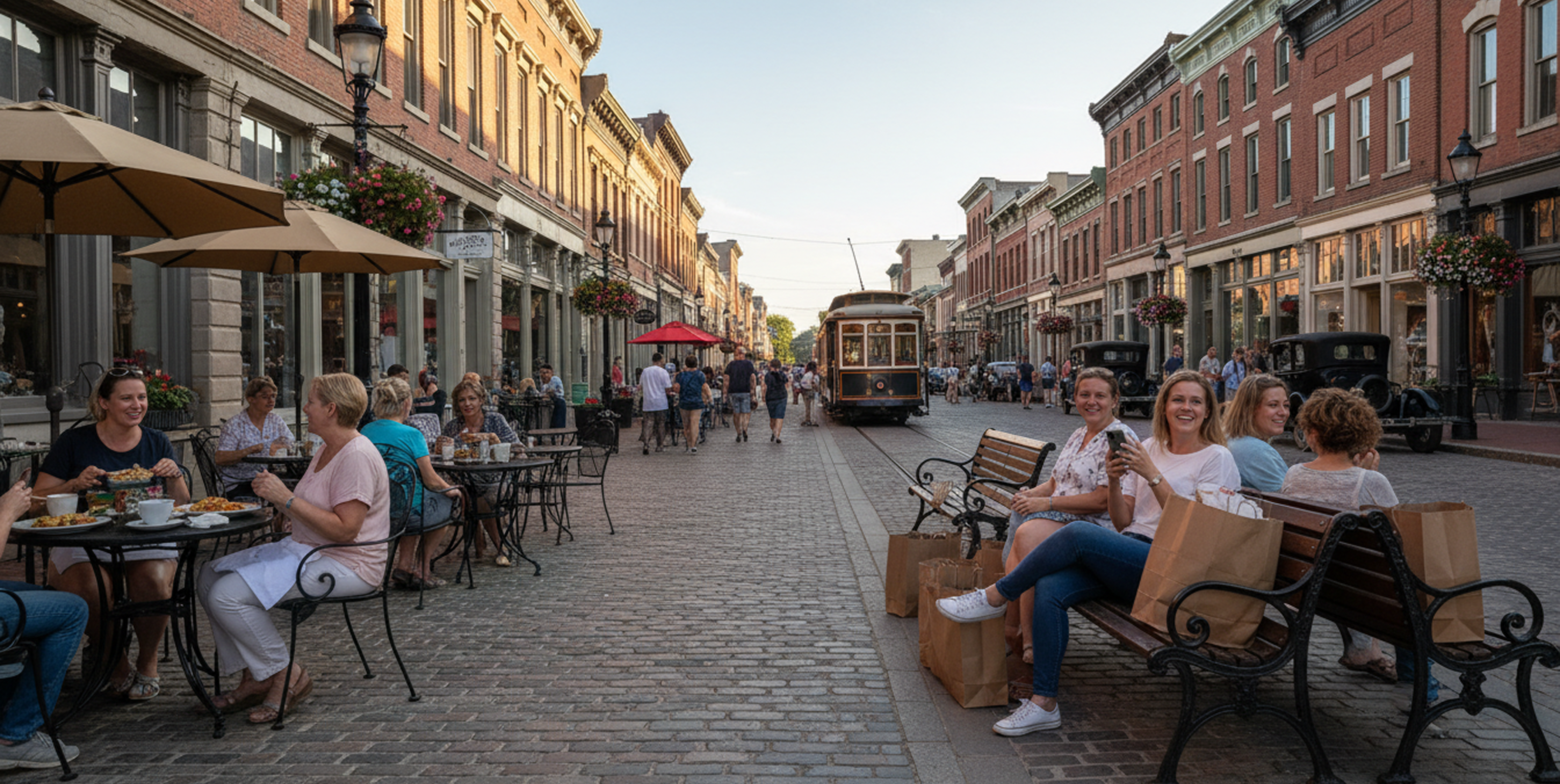
400 million people visited a Main Street in 2024. Here’s how self-guided digital tours turn foot traffic into extended time - and spending - in your district.
Getting people to show up is one problem. Getting them to stay long enough to spend money is a different one entirely — and for most small towns and downtown districts, it's the harder one.
A visitor who parks on Main Street, walks to the one attraction they came for, and leaves ninety minutes later has touched maybe two or three businesses. A visitor who spends three hours exploring — who discovers the building with the interesting history two blocks off the main drag, who stops for coffee because they were passing a café between tour stops — is a different kind of economic contributor.
This is the logic behind self-guided tours as an economic development tool. Not tourism for its own sake, but tourism structured to move people through a district deliberately, exposing them to more of it for longer.
What the Data on Downtown Visitation Actually Shows
Main Street America's 2024 annual report puts the scale of the opportunity in plain terms: 400 million people visited a Main Street in 2024. These aren't destination tourists flying in from across the country. They're people already in the region — driving through, visiting family, passing by — who chose to stop. The question is what they did once they got there, and how much of the district they actually saw.
The same report documents that every $1 invested in local Main Street program operations returns $18.03 in new public and private investment. That's a striking multiplier, and it points to a consistent pattern: when downtowns give people structured reasons to engage, the economic returns compound. The investment case for programming — including self-guided tours — isn't theoretical.
Heritage visitors specifically are well-documented as high-value. Research from the Travel Industry Association has found that heritage tourists stay longer and spend more per trip than visitors traveling for other purposes. That's not because they're wealthier; it's because they're oriented. They arrived with a reason to be there, and they tend to follow that reason through.
The Activation Problem
The challenge most small towns face isn't a lack of content. Most communities with any history at all have stories worth telling — buildings with interesting pasts, former industries, notable figures, landscape features that shaped the town's development. The content exists.
What often doesn't exist is a mechanism to surface it to someone standing in the middle of the downtown corridor who doesn't already know to look for it. A visitor who came for the farmers market and has an hour to kill isn't going to read a historical marker if they don't walk past it. They're not going to find the 1890s mill building if nobody pointed them toward it.
A self-guided digital tour solves exactly this problem. It gives that visitor something to do with their extra time, routes them past businesses they wouldn't have discovered independently, and extends their stay in the district without requiring any additional staff time to deliver the experience.
What Digital Adds That Print Can't
Printed walking tour brochures have been a Main Street staple for decades, and they're not useless — but they have a fundamental limitation. They're static. The content doesn't change. They require a visitor to find and pick up the brochure before they can start. They provide no location context while walking. And they generate no data about who used them or what they engaged with.
A GPS-aware mobile tour removes each of those constraints. A visitor scans a QR code posted at the visitor center, the trailhead, or the parking lot entrance. The tour opens immediately in their browser — no download, no account. Their location appears on the map. As they walk, the interface shows them which stop is nearest and how far it is. Stops they've visited are marked. The whole route is visible at once.
From the district's perspective, every session generates real data: how many people started the tour, which stops they visited, where they came from geographically, how long their sessions lasted. That's information a brochure has never been able to provide, and it's exactly the kind of evidence that supports programming budgets, grant reporting, and board conversations about whether the investment is working.
A Practical Starting Point
Most towns that would benefit from this already have the raw material. There's usually a chamber of commerce walking tour brochure, a historical society booklet, or a heritage trail guide sitting somewhere in print — content that was researched and written but is doing limited work because its delivery format limits its reach.
Digitizing that content, making it GPS-aware, and putting it behind a scannable QR code posted in high-traffic locations is a realistic project for most organizations. It doesn't require producing new content from scratch. It requires activating what already exists.
Platforms like DestinationHub are built specifically for this conversion — taking existing stop-by-stop content and making it interactive, location-aware, and measurable without requiring technical staff to manage it.
The visitors are already coming. The question is whether your district is giving them a reason to stay.